Welcome to my personal website!
I am an applied economist working mainly with empirical methods, with research interests in international trade, firm performance, and policy-relevant economic analysis.
Since 2025, I have worked at STATEC Research, the research department of STATEC, Luxembourg's National Institute of Statistics and Economic Studies. Previously, I worked as a consultant for STATEC's Département Conjoncture, Modélisation et Prévisions (CMP) and as a A postdoctoral researcher is a temporary research position after a Ph.D., usually focused on publications and further development of an academic research profile.Un chercheur postdoctoral occupe un poste de recherche temporaire après le doctorat, généralement centré sur les publications et le développement du profil scientifique.Ein Postdoktorand ist eine befristete Forschungsposition nach der Promotion, meist mit Schwerpunkt auf Publikationen und der weiteren Entwicklung des wissenschaftlichen Profils.Eng Postdoc-Positioun ass eng temporär Fuerschungsplaz no engem Ph.D., normalerweis fir weider wëssenschaftlech Aarbecht a Publikatiounen.Un investigador posdoctoral ocupa un puesto temporal de investigación después del Ph.D., normalmente orientado a publicaciones y al desarrollo del perfil académico.Un ricercatore post-dottorale occupa una posizione temporanea di ricerca dopo il Ph.D., di solito orientata alle pubblicazioni e allo sviluppo del profilo accademico.Um investigador de pós-doutoramento ocupa uma posição temporária de investigação após o Ph.D., geralmente centrada em publicações e no desenvolvimento do perfil académico.Постдокторант — это временная исследовательская позиция после получения Ph.D., обычно ориентированная на научные публикации и развитие академического профиля.博士后研究员是取得 Ph.D. 后的临时研究职位,通常侧重于发表研究成果并发展学术履历。Postdoc Ph.D. पूरा करने के बाद की अस्थायी शोध-स्थिति है, जिसमें मुख्य रूप से शोध प्रकाशन और अकादमिक प्रोफ़ाइल विकसित की जाती है।باحث ما بعد الدكتوراه هو منصب بحثي مؤقت بعد الحصول على Ph.D.، ويركز عادةً على النشر العلمي وتطوير المسار الأكاديمي.ポスドク研究員とは、Ph.D.取得後の任期付き研究職で、通常は研究成果の発表と研究者としての実績形成に重点を置きます。 at the University of Luxembourg.
My most recent research focuses on international trade, exploring trade policy, the welfare effects of trade shocks, the role of product quality, and the granularity of trade flows.
I have taught courses in macroeconomics, public economics, applied general equilibrium, international trade, and development policy at both undergraduate and graduate levels.
I obtained a Doctor of Philosophy Doctor of Philosophy. Système national français : doctorat en sciences économiques. Doctor of Philosophy. Deutsches Hochschulsystem: Doctor rerum politicarum (Dr. rer. pol.). Doctor of Philosophy. Lëtzebuergeschen a franséischsproochege System: doctorat / Doktorat. Doctor of Philosophy. Sistema universitario español: doctorado. Doctor of Philosophy. Sistema universitario italiano: dottorato di ricerca. Doctor of Philosophy. Sistema universitário português e lusófono: doutoramento / doutorado. Doctor of Philosophy. भारतीय उच्च शिक्षा प्रणाली: डॉक्टर ऑफ फिलॉसफी (Ph.D.). Doctor of Philosophy. النظام الجامعي العربي: درجة الدكتوراه. Доктор философии (Doctor of Philosophy). В России, Украине и Беларуси примерно соответствует степени кандидата наук. Doctor of Philosophy. 日本の大学制度では博士号に相当します。 哲学博士 (Doctor of Philosophy)。在中国大致对应博士学位。 in International Economics from the Paris School of Economics and Université Paris 1 Panthéon-Sorbonne under the supervision of Professor Lionel Fontagné. Full text of my dissertation is publicly available: here and here.
Most recent output
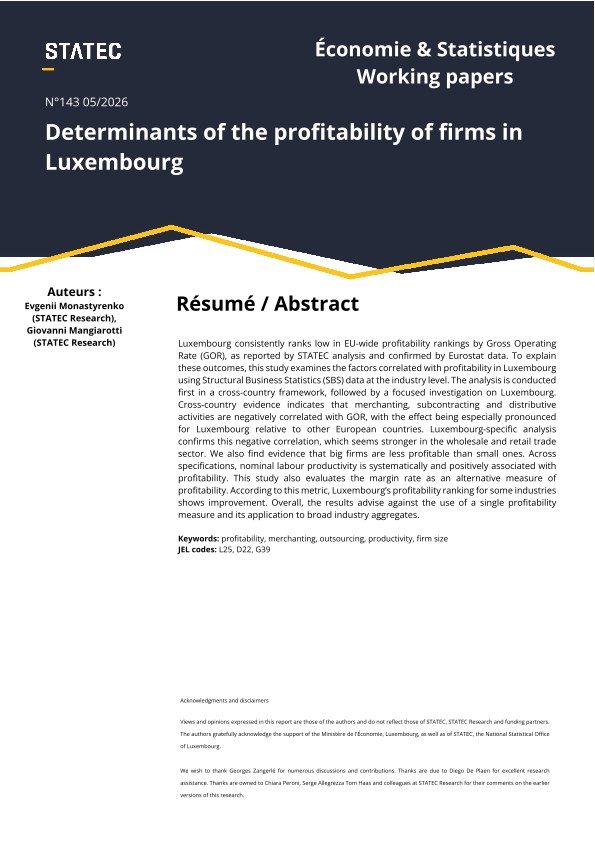
Determinants of the profitability of firms in Luxembourg
ECOSTAT Working Papers 143, STATEC, 2026
Abstract
Luxembourg consistently ranks low in EU-wide profitability rankings by Gross Operating Rate (GOR), as reported by STATEC analysis and confirmed by Eurostat data. To explain these outcomes, this study examines the factors correlated with profitability in Luxembourg using Structural Business Statistics (SBS) data at the industry level. The analysis is conducted first in a cross-country framework, followed by a focused investigation on Luxembourg. Cross-country evidence indicates that merchanting, subcontracting and distributive activities are negatively correlated with GOR, with the effect being especially pronounced for Luxembourg relative to other European countries. Luxembourg-specific analysis confirms this negative correlation, which seems stronger in the wholesale and retail trade sector. We also find evidence that big firms are less profitable than small ones. Across specifications, nominal labour productivity is systematically and positively associated with profitability. This study also evaluates the margin rate as an alternative measure of profitability. According to this metric, Luxembourg’s profitability ranking for some industries shows improvement. Overall, the results advise against the use of a single profitability measure and its application to broad industry aggregates.
 d'Lëtzebuerger Land
Published research papers
- Russian consumers pay higher prices for food products due to self-imposed embargo.
- Prices for embargoed products increased quickly and stayed high for at least 2 years.
- The price shock propagated through the economy via sectoral input-output linkages.
- Price increases translated into significant welfare costs for Russian consumers.
The paper shows how a targeted import embargo can raise everyday consumer prices and reduce welfare beyond the directly affected goods.
Abstract
In August 2014, the Russian Federation implemented an embargo on select food and agricultural imports from Western countries in response to previously imposed economic sanctions. In this paper we quantify the effect of this embargo on consumer prices and welfare in Russia. We provide evidence for the direct effect on monthly consumer prices with a difference-in-differences approach. The embargo caused prices of embargoed goods to rise by up to 7.7% – 14.9% in the short run and by on average 2.6% – 8.1% until at least 2016. The results further suggest the shock was transmitted to non-embargoed sectors through domestic input-output linkages. We then construct a general equilibrium Ricardian model of trade with input-output linkages and goods that are tradable, non-tradable or embargoed. The model-based counterfactual analysis predicts the overall price index in Russia to have increased by 0.33% and welfare to have declined by 1.84% due to the embargo.
- A negative trend is observed in the eco-efficiency of EU electricity producers.
- Thoroughly regulated domestic horizontal mergers do not affect eco-efficiency.
- Regulators neglect the detrimental impact of vertical mergers.
- Merger regulation should rely on predictions of eco-efficiency outcomes.
- Regulators should address cross-border and domestic mergers in different ways.
The paper shows why merger policy in energy markets should consider environmental efficiency, not only prices or conventional productivity.
Abstract
The European electricity industry was recently liberalized. In response, there was a surge of mergers and acquisitions (M&As). This study addresses the effects of M&As on the eco-efficiency of European electricity producers in 2005–2013. The environmental production technology comprises CO2 emissions as an undesirable output. I compute eco-efficiency using data envelopment analysis (DEA) and the Malmquist-Luenberger productivity index, which are both based on radial directional distance function. I observe a decreasing trend in average eco-efficiency, which contradicts the previously documented moderate efficiency gains of liberalization. The effects of M&As are isolated using second-step fractional regression. The domestic horizontal M&As, which are systematically regulated by the European Commission, have no impact. Although one cross-border horizontal deal has a same-year effect of roughly −3%, this effect becomes approximately +1.5% over a two-year timespan. Vertical domestic M&As have a short-run negative impact of 3.6% that does not persist over time. Vertical international M&As reduce the eco-efficiency by 2.1% two years after their completion. Limited evidence suggests that the conglomerate deals are at least not harmful. The policy implication is that the merger regulation should be based on DEA eco-efficiency measures. Regulators should devote more attention to cross-border M&As and particularly to vertical deals.